Do More Google Reviews Actually Lead to More Calls and Bookings?

Yes, reviews can help. No, the relationship is not 'double the reviews, double the jobs.' The useful answer sits in the middle.
Reviews can influence both visibility and conversion. Google says more reviews and positive ratings can help local ranking, while consumer research shows strong reviews make people more likely to contact and use a business. But reviews are only one part of the route from search to booked job.
Business owners are right to be suspicious of fluffy metrics. A bigger review count is nice. It is not the same thing as money in the bank.
So the sensible question is not, 'Can we get to 200 reviews?' It is, 'If we improve the review profile, are more people likely to find us, trust us and contact us?'
That answer is much more useful — and it is also where the evidence is strongest.
Reviews do two different jobs
1. They can help you appear more prominently
Google's own guidance says local ranking is mainly based on relevance, distance and prominence. Under prominence, Google specifically says review count and positive ratings can help local ranking. That is as close to a straight answer as Google gives.
But reviews are not a magic lever. You can have more reviews than a competitor and still rank below them because categories, proximity, website signals and other factors matter too.
Sterling Sky's 2025 testing is a good example of why simple 'more is always better for ranking' advice is misleading. In three tests, listings moving from nine to ten reviews saw a small ranking lift. When separate listings moved from ten to eleven, the same lift did not appear. Their conclusion was not that reviews stop mattering; it was that ranking benefits are not linear.
2. They can make the person who sees you more likely to choose you
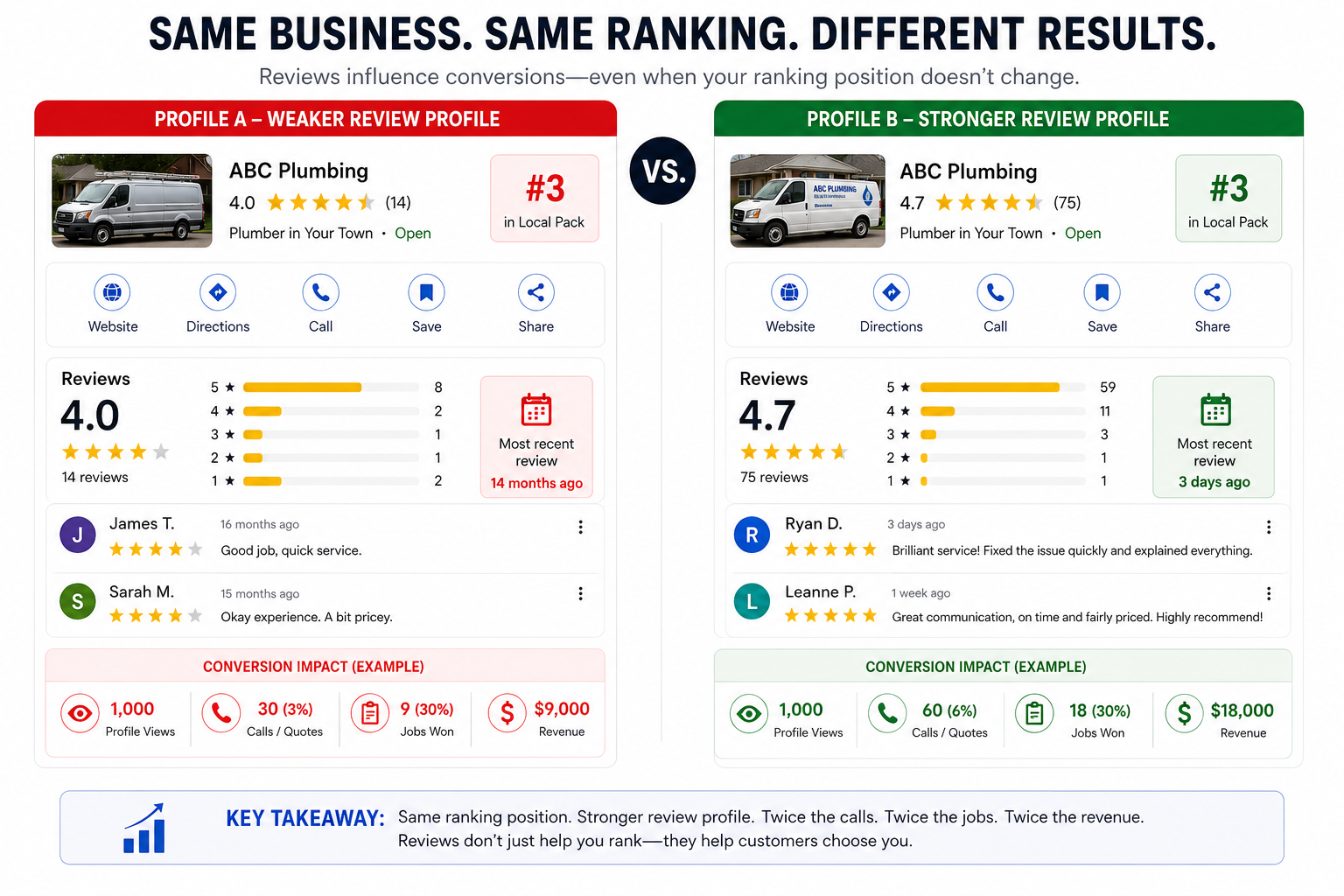
This is the part that gets overlooked. Even when one more review does nothing measurable to ranking, it can still make the profile more convincing.
In BrightLocal's 2026 consumer review survey, 85% said positive reviews made them more likely to use a business.
The same research found that after positive reviews, some people were ready to act immediately: 20% said they would contact the business and 20% would make an appointment. Many others kept researching, often by visiting the website or reading more reviews. In other words, reviews help move the buyer forward, but the rest of your online presence still has to finish the job.
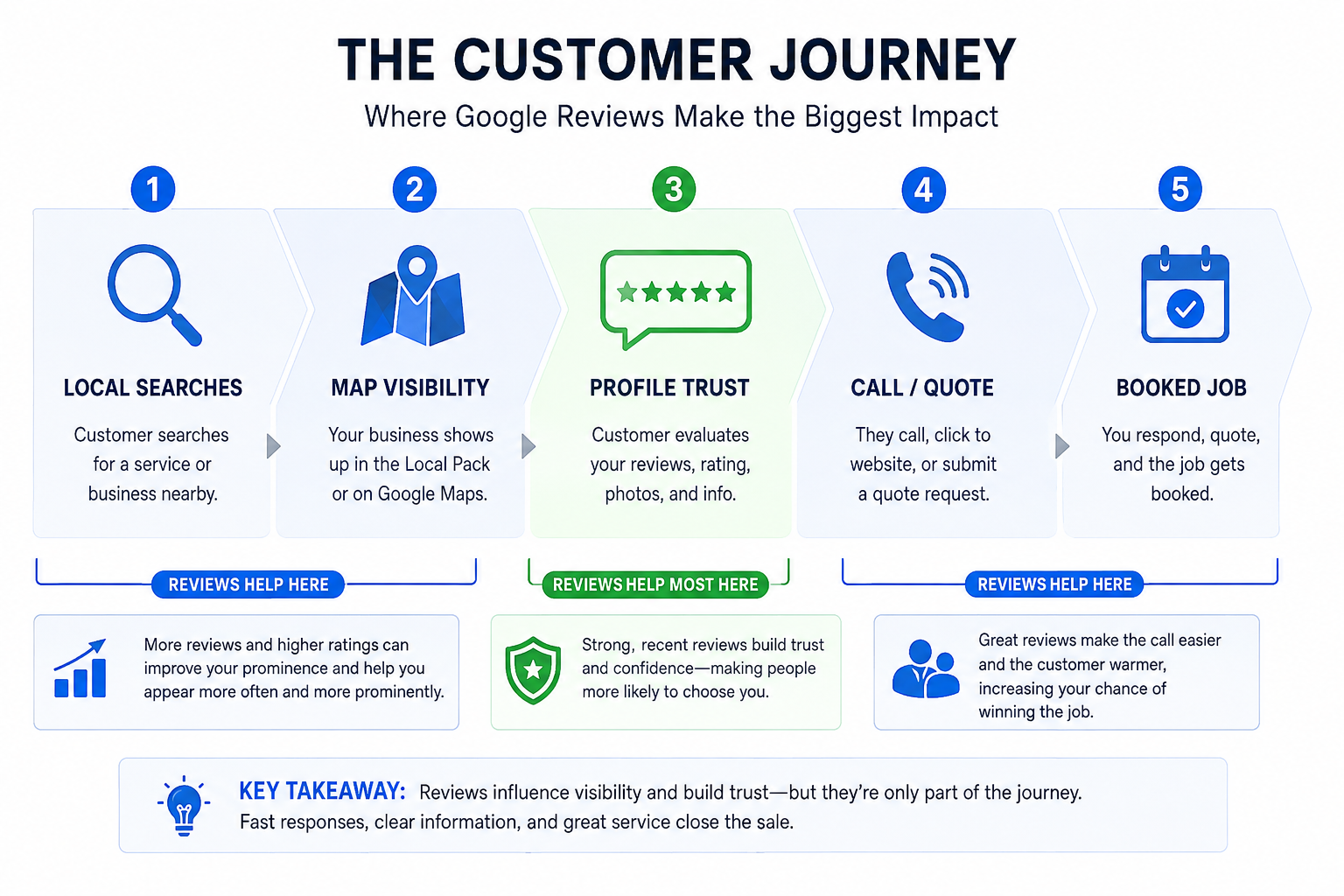
Think of revenue as a chain, not a review counter. For a local trades business, the path is roughly this:
- You appear in the customer's search.
- Your profile looks trustworthy enough to make the shortlist.
- The customer clicks, calls or asks for a quote.
- Someone responds quickly and professionally.
- The price, availability and service fit.
- The job gets booked.
Reviews mainly strengthen steps one and two. They can also make step three easier because the customer is already warmer when they call. But they cannot fix a phone that goes unanswered, a quote that takes three days to arrive, or a website that makes the company look dubious.
A simple way to think about the money
Imagine your profile is seen by 1,000 local searchers in a month. If 3% of those people contact you, that is 30 enquiries. If a stronger profile moves that contact rate to 4%, you now have 40 enquiries from the same visibility.
Nothing about that example promises a real-world 1-point lift. It simply shows why conversion matters. You do not always need more traffic to create more opportunity. Sometimes you need more of the people already seeing you to believe you are worth calling.
This is why a review strategy should be judged against calls, quote requests, booked appointments and revenue where tracking allows — not just the review count itself.
So how many reviews do you actually need?
There is no universal number. A plumber with 70 reviews might look strong in one town and weak in another where the top three firms all have 400. A new appliance repair business with 18 good recent reviews may already look credible in a smaller local market.
The right target is your local review gap. Search the services you actually sell in the areas you actually cover. Compare your count, rating, recency and response pattern with the businesses customers are seeing next to you.
That gives you a commercial target instead of an arbitrary vanity number.
What matters besides the count
- Rating: a high count with a weak rating can amplify the wrong message.
- Recency: customers want evidence of what the business is like now.
- Consistency: a steady flow looks more credible than one big burst followed by silence.
- Responses: future customers notice whether the owner engages with feedback.
- Profile completeness: correct hours, services, photos and contact details reduce doubt.
- Website and speed-to-lead: once the review earns the click, the rest of the business has to convert it.
The useful answer
More Google reviews can absolutely contribute to more calls and bookings. They can help local visibility, reduce perceived risk, and make your listing more attractive when a customer is comparing options.
Just do not sell yourself the fairy tale that review count alone creates revenue. The businesses that make the most money from reviews connect the whole chain: visibility, trust, easy contact and fast follow-up.
Want to see where you are losing ground?
Get your free Reputation Audit →LocalTrust can audit your review gap, profile activity and local competitors, then show you the first fixes worth making.