How to Turn Every Completed Job Into More Reviews and More Future Customers
The best time to build trust for the next customer is right after you have finished a good job for the current one.
Stop treating reviews as something you remember to ask for when business is quiet. Make the request part of closing the job, use one easy link, send it consistently, and follow the same process for every eligible customer.
Most trades businesses already have the raw material for a strong reputation. It is sitting in yesterday's completed jobs.
A boiler fixed before dinner. A blocked drain cleared on a Sunday. A washing machine repaired without the customer buying a new one. The customer is relieved, the job is done, and the experience is still fresh. Then everyone moves on.
That is where the opportunity disappears. Not because the customer was unhappy. Because nobody made leaving a review easy at the right moment.
The problem is not usually willingness. It is memory and friction.
Customers do leave reviews when businesses ask. Recent BrightLocal research found that the overwhelming majority of consumers are open to writing reviews, and asking significantly increases the chance they actually do it.
The issue is that a verbal 'Would you mind leaving us a review?' at the front door is easy to forget. By the time the customer finds your profile later, dinner is on, the kids need something, or the next problem has taken over.
A direct link removes the work. A consistent process removes the need for your engineer to remember.
Build the request into the end of the job
The cleanest system is boring on purpose. No points. No prize draw. No complicated script. Just a repeatable handoff from completed job to review request.
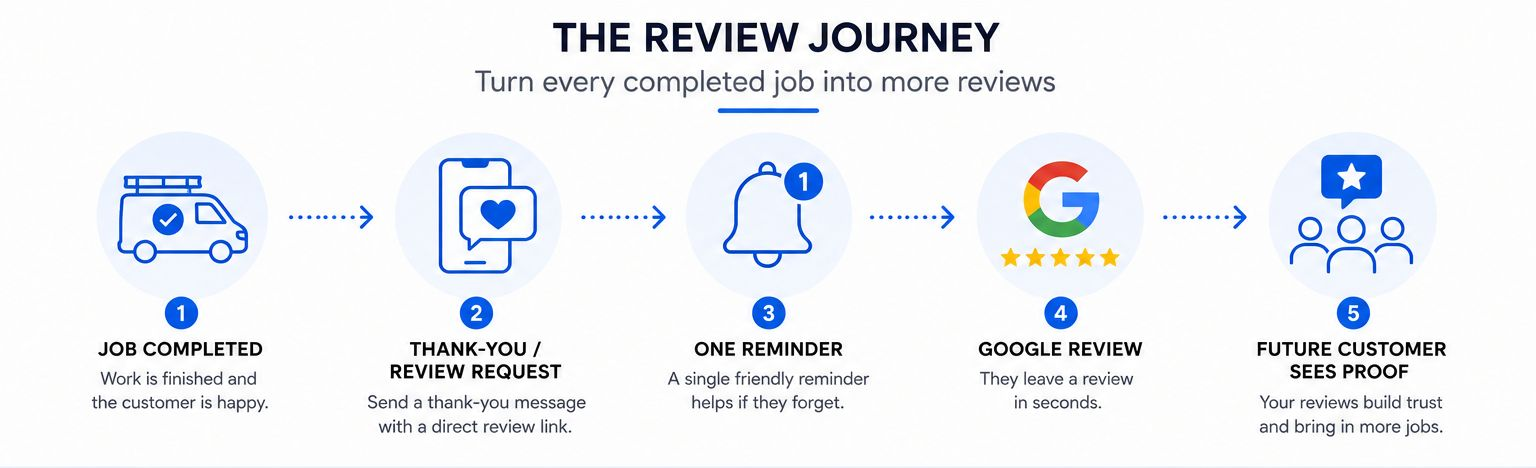
- Mark the job complete. Whatever system you use — CRM, booking software, spreadsheet or a simple admin process — there needs to be one clear moment when the work is finished and the review workflow can begin.
- Send the request while the experience is fresh. For many home-service jobs, that means shortly after completion, once the customer has had the chance to see that the problem is actually solved. The exact timing can vary, but weeks later is usually too late.
- Use a direct Google review link. Do not make the customer search for your business and then find the review button. Google lets verified businesses create a direct review link. One tap should take them where they need to go.
- Send one sensible reminder. People forget. One reminder can recover reviews that would otherwise disappear. Three or four increasingly desperate nudges can do the opposite. Keep it respectful.
- Reply when the review arrives. The review is not the end of the process. A genuine owner response shows future customers that feedback is noticed, not just collected.
What should the message actually say?
The best review request does not start by dropping a Google link into the customer's phone. Start with a simple check-in.
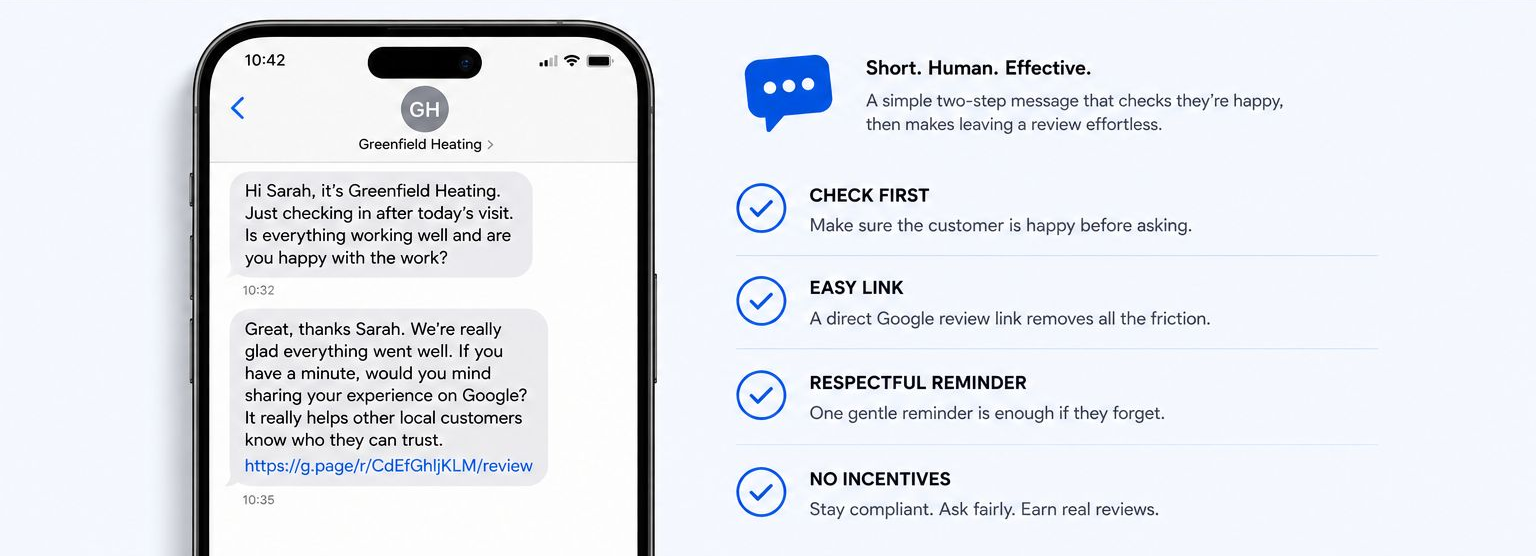
Message 1 — The check-in: "Hi Sarah, it's Greenfield Heating. Just checking in after today's visit. Is everything working well and are you happy with the work?"
That first message has one job: make sure the customer is actually satisfied with the service before moving on. If they reply with a problem, the business has a chance to deal with it first instead of blindly asking for a review while something is still wrong.
Once everything is sorted, the review request can follow.
Message 2 — The review request: "Great, thanks Sarah. We're really glad everything went well. If you have a minute, would you mind sharing your experience on Google? It really helps other local customers know who they can trust. [review link]"
That is enough. No long sales message, asking for five stars, or telling customers what to write. Simply send a natural follow-up after a real customer experience.
The important part is the sequence: Check the customer is okay → resolve any issue if needed → send the review request → follow up once if they forget. That feels much more like good customer service than a review campaign, which is exactly why it works.
One rule matters more than all the copywriting
Ask fairly. Google says reviews must reflect genuine experiences and prohibits incentives in exchange for reviews. UK CMA guidance is also clear that businesses should not manipulate the overall picture by selectively collecting only positive feedback or commissioning fake reviews.
In practical terms: do not run a 'happy customer goes to Google, unhappy customer goes somewhere private' system. That is review gating. Your review process should be designed to collect honest feedback, not manufacture a perfect score.
Every completed job has two values: the money from the job itself, and the trust it can create for the next customer.
How completed jobs turn into future customers
A good review does more than make the star count look nicer. It tells the next homeowner something your own website cannot say with the same credibility: someone else trusted you, paid you, and was happy with the result.
Do that consistently and the profile changes. Instead of a handful of old testimonials, there is a running record of real work being completed now. For a customer deciding between two local trades businesses, that can remove a lot of perceived risk.
BrightLocal's 2026 consumer research found that positive reviews made 85% of respondents more likely to use a business. Many still did more research before buying — which is why your website, pricing information and response speed matter too — but the review is often what earns you that next look.
What to measure each month
- How many completed jobs were eligible for a review request?
- How many requests were actually sent?
- How many new reviews arrived?
- How recent is the latest review?
- What is the average rating doing over time?
- Are owner replies being posted consistently?
- Are Google Business Profile calls, website clicks or quote requests moving in the right direction?
The goal is not to squeeze a review out of every customer. The goal is to stop good work from disappearing without a trace.
Want to see where you are losing ground?
Get your free Reputation Audit →LocalTrust can audit your review gap, profile activity and local competitors, then show you the first fixes worth making.